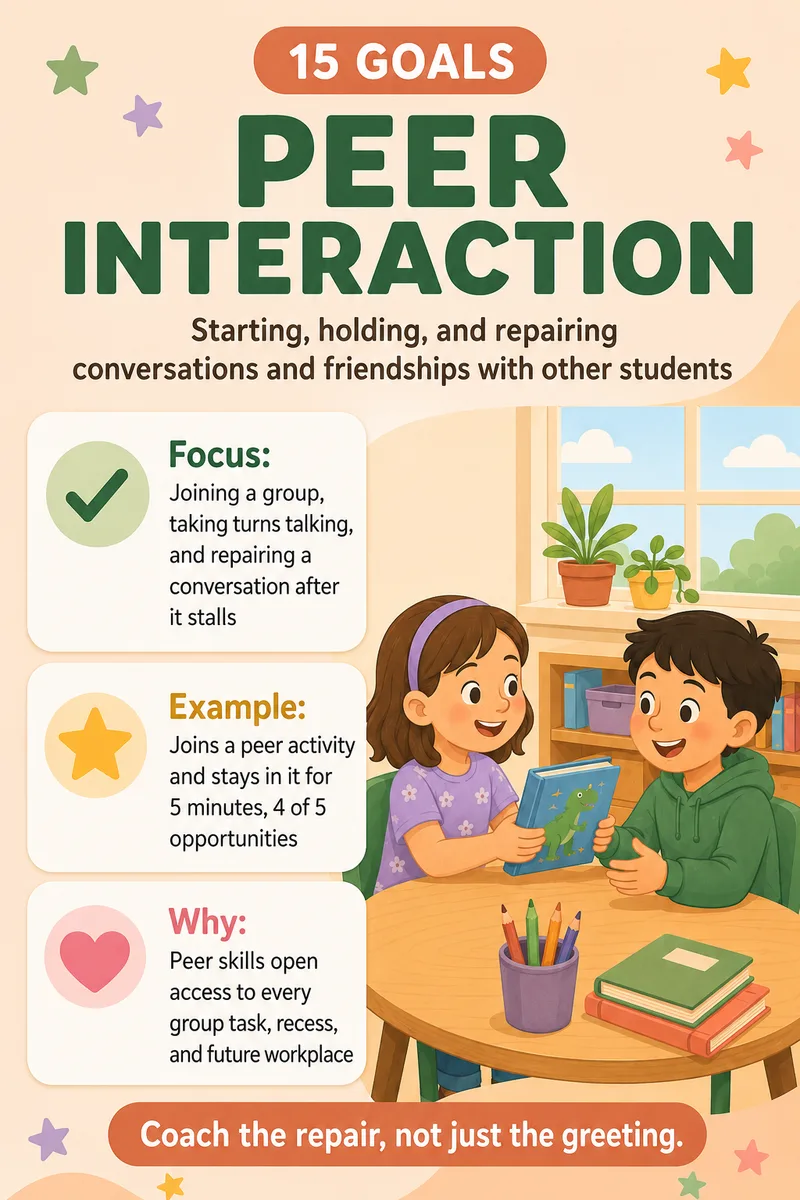
15 Peer Interaction IEP Goals, Preschool Through High School
Peer interaction goals target the specific mechanics of connecting with another student — initiating, taking turns, reading a peer's reaction, resolving a small conflict — rather than "socializing" as a vague catch-all. This matters most right when a class roster resets: a new classroom, new seating chart, or new grade means a student's existing peer relationships don't automatically transfer, and initiating with unfamiliar peers is a harder skill than maintaining an established friendship.
Free · no email required · opens your browser's print dialog
Preschool & Pre-K
- 1[student] will engage in parallel play alongside a peer for [X] minutes without conflict, across 3 consecutive observations.
- 2[student] will initiate a social interaction with a peer (offering a toy, showing an item) without adult prompting, in 4 of 5 observed opportunities.
- 3[student] will respond to a peer's greeting or bid for attention (name, wave, “hi”) within 5 seconds, in 4 of 5 opportunities.
Kindergarten – 2nd
- 4[student] will initiate a conversation with a peer using a greeting and a question, in 4 of 5 observed opportunities.
- 5[student] will use an appropriate phrase to ask to join a peer group or activity, in 4 of 5 observed opportunities.
- 6[student] will identify at least 1 peer as a friend and state 1 reason why, in 4 of 5 opportunities across the school year.
3rd – 5th Grade
- 7[student] will initiate a conversation with an unfamiliar or less-familiar peer using a greeting and an open-ended question, in 4 of 5 observed opportunities.
- 8[student] will use a taught conflict-resolution strategy (compromise, take turns, get an adult) to resolve a peer conflict, in 4 of 5 documented opportunities.
- 9[student] will maintain a friendship with at least 1 peer across the school year, as reported by self, teacher, or family observation.
6th – 8th Grade
- 10[student] will identify at least [X] different peer groups in their school setting and describe expectations for interacting with each, with 80% accuracy across 4 of 5 discussions.
- 11[student] will engage appropriately with a peer group during an unstructured setting (lunch, passing period) without the target behavior, in 4 of 5 observed opportunities.
- 12[student] will maintain at least 1 peer friendship across a semester, with support fading, as reported by self, teacher, or family observation.
9th – 12th Grade
- 13[student] will maintain at least 1 peer relationship across the school year, with support fading, as reported by self, teacher, or family observation.
- 14[student] will collaborate with a diverse group (unfamiliar peers, a mixed-ability team) to complete a shared task, contributing equitably, across 4 of 5 group tasks.
- 15[student] will identify a socially difficult situation (peer pressure, exclusion, miscommunication) and select an appropriate response from at least [X] options, in 4 of 5 documented opportunities.
How to teach peer interaction in the classroom
Peer interaction is taught with explicit instruction, structured practice, and support that fades. Name the specific skill (joining a group, taking turns in conversation, handling losing a game, repairing a misunderstanding), model it and a non-example, and practice through role-play before expecting it in the moment. Set up structured opportunities — a planned activity with a defined role, a peer buddy, a small group with a shared goal — rather than hoping interaction happens at recess. Prompt discreetly during the interaction and step back as the student carries it. Coach the peers too where appropriate, so the student is not the only one adjusting. Debrief afterward: what went well, what was tricky, what to try next time. Reinforce attempts, not just smooth outcomes.
How to measure it
Direct observation across a few natural opportunities (recess, group work, lunch) works better here than a single staged trial, since peer interaction is highly dependent on the specific peer and setting. Track both the behavior (did the student initiate/respond) and, where relevant, whether it was reciprocated — a student can execute a skill correctly and still get an unpredictable peer response, which is worth noting separately from the student's own performance.
Where these goals come from
Each goal above is drawn from a grade-band goal bank, where you can see it alongside the other targets it is usually paired with: Social Skills goals, Preschool & Pre-K; Social Skills goals, Kindergarten – 2nd Grade; Social Skills goals, 3rd – 5th Grade; Social Skills goals, 6th – 8th Grade; Social Skills goals, 9th – 12th Grade.
Related skills
A flat following-directions goal is often really a breakdown in one of these skills. If the data does not move, check whether the real target is here instead:
- Requesting & Functional Communication IEP goals — getting a need met without having to escalate
- Emotional Regulation IEP goals — recognising a feeling and doing something about it before it escalates
- Problem Solving & Flexibility IEP goals — trying a second approach when the first one fails
Common questions
Should peer interaction goals name a specific peer?
No — naming a specific classmate ties the goal to a relationship the team can't control (that student could move, change classes, or the friendship could just change). Write the goal around the skill (initiating, joining, resolving conflict) so it holds up regardless of which peer is involved.
How is this different from a general social skills goal?
General social skills goals can cover things like emotional regulation or reading nonverbal cues in isolation. Peer interaction goals specifically target the back-and-forth of engaging with another student — initiating, sustaining, and repairing that interaction.
Need a goal built from your student's baseline? Generate one for your student →