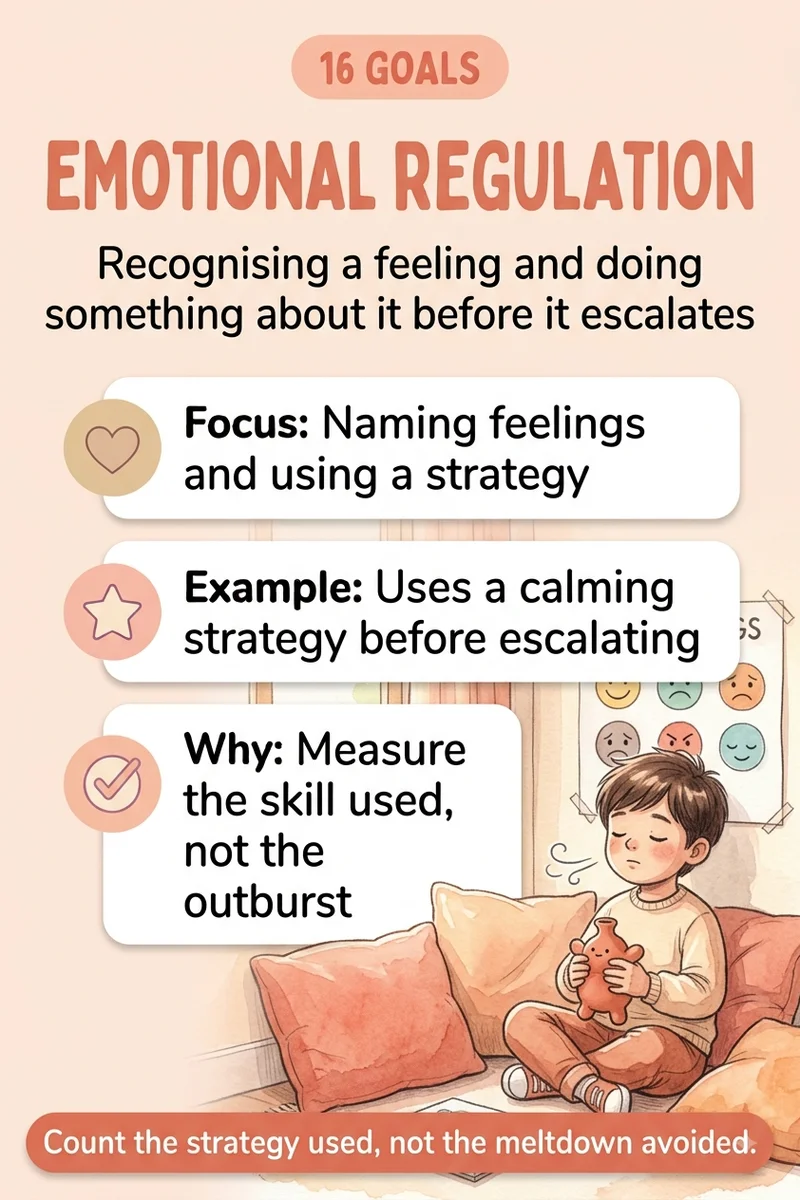
16 Emotional Regulation IEP Goals, Preschool Through High School
Regulation goals fail when they measure the absence of an outburst rather than the presence of a skill. "Will not have a meltdown" is not a goal, it is a wish — and it gives staff nothing to teach.
Free · no email required · opens your browser's print dialog
Preschool & Pre-K
- 1During a transition from a preferred activity, [student] will use a visual cue (first/then card) to move to the next activity without a tantrum, in 4 of 5 observed transitions.
- 2When frustrated, [student] will use a taught calming strategy (deep breath, squeeze toy) with adult prompting, in 4 of 5 opportunities.
- 3[student] will remain in a designated area (circle time, table) for [X] minutes with no more than 1 verbal redirection, across 3 consecutive observations.
- 4[student] will identify a feeling (happy, sad, mad, frustrated) using a picture or word when asked, with 80% accuracy across 4 of 5 trials.
Kindergarten – 2nd
- 5When frustrated or upset, [student] will independently use a taught calming strategy from a choice board before engaging in the target behavior, in 4 of 5 observed opportunities.
- 6[student] will identify their own emotional state using a 1-5 scale or feelings chart, with 80% agreement with an adult's rating, across 4 of 5 trials.
- 7[student] will remain in the classroom during a non-preferred task for [X] minutes with no more than 1 redirection, across 3 consecutive observations.
- 8[student] will independently use a self-selected calm-down space when identified as escalating, without adult prompting, in 4 of 5 observed opportunities.
3rd – 5th Grade
- 9When experiencing frustration or conflict, [student] will independently select and use a coping strategy from a personal toolbox before the behavior escalates, in 4 of 5 observed opportunities.
- 10[student] will identify early warning signs of their own escalation and request support before reaching a crisis level, in 4 of 5 documented opportunities.
- 11[student] will remain in the general education classroom during a non-preferred task or transition for the full period, with no more than 1 redirection, across 4 of 5 observations.
6th – 8th Grade
- 12Across all class periods, [student] will independently use a coping strategy before escalating, with no more than 1 staff prompt per day, across 4 of 5 school days.
- 13[student] will identify personal escalation triggers and proactively request a break or check-in before reaching a crisis level, in 4 of 5 documented opportunities across settings.
- 14[student] will remain in class during a non-preferred task or peer conflict without leaving the room, with no more than 1 redirection, across 4 of 5 observed class periods.
9th – 12th Grade
- 15[student] will independently use a self-selected coping strategy to manage frustration or stress during an unstructured setting (hallway, lunch, study hall), in 4 of 5 documented opportunities.
- 16[student] will identify personal triggers and request support before reaching a crisis level, in 4 of 5 opportunities across all settings.
How to teach emotional regulation in the classroom
Emotional regulation is taught before the moment it is needed. During calm times, help the student build a vocabulary for feelings and notice their own early body signals — the point where a feeling is still small. Teach a short set of concrete strategies (a breathing pattern, a movement break, a quiet spot, asking for help) and practice each through role-play so it is available under stress. Use a visual scale or check-in so the student can name where they are without a long conversation. Co-regulate first: a calm adult, fewer words, and space, then prompt the strategy. Pre-teach and pre-warn before known hard moments. Reinforce the use of a strategy — even a partial one — and debrief afterward briefly and forward-looking: what was the trigger, what worked, what to try next time.
How to measure it
Measure the replacement, not the removal. Count how often the student uses the taught strategy before escalation, which is an action anyone can see. If the referral concern is the behaviour itself, the frequency of that behaviour belongs in the behaviour intervention plan, not in the goal.
Where these goals come from
Each goal above is drawn from a grade-band goal bank, where you can see it alongside the other targets it is usually paired with: Behavior goals, 3rd – 5th Grade; Behavior goals, 6th – 8th Grade; Behavior goals, 9th – 12th Grade; Behavior goals, Kindergarten – 2nd Grade; Behavior goals, Preschool & Pre-K.
Related skills
A flat following-directions goal is often really a breakdown in one of these skills. If the data does not move, check whether the real target is here instead:
- Impulse Control IEP goals — the pause between the urge and the action
- Self-Monitoring IEP goals — noticing your own performance while it is happening
- Problem Solving & Flexibility IEP goals — trying a second approach when the first one fails
Common questions
Is an emotional regulation goal a behavior goal?
It is usually tracked as one, because it is observed through actions — using a strategy, requesting a break, returning to task after a setback. But the teaching is skill instruction done during calm times, not consequences applied during escalation.
Should the goal focus on reducing outbursts or on using a strategy?
On using a strategy. "Will not have outbursts" gives the student nothing to do. Effective goals name the replacement — take three breaths, move to the calm corner, ask for help, use a feelings scale — so there is a behavior to teach, prompt, and reinforce.
How do you measure emotional regulation without only counting incidents?
Count the coping strategy: how often the student uses a taught strategy independently, or the time to return to task after an upset. Rating scales completed by the student add a self-awareness measure. A pure incident count shows the behavior happened, not whether the skill is growing.
Further reading
Need a goal built from your student's baseline? Generate one for your student →