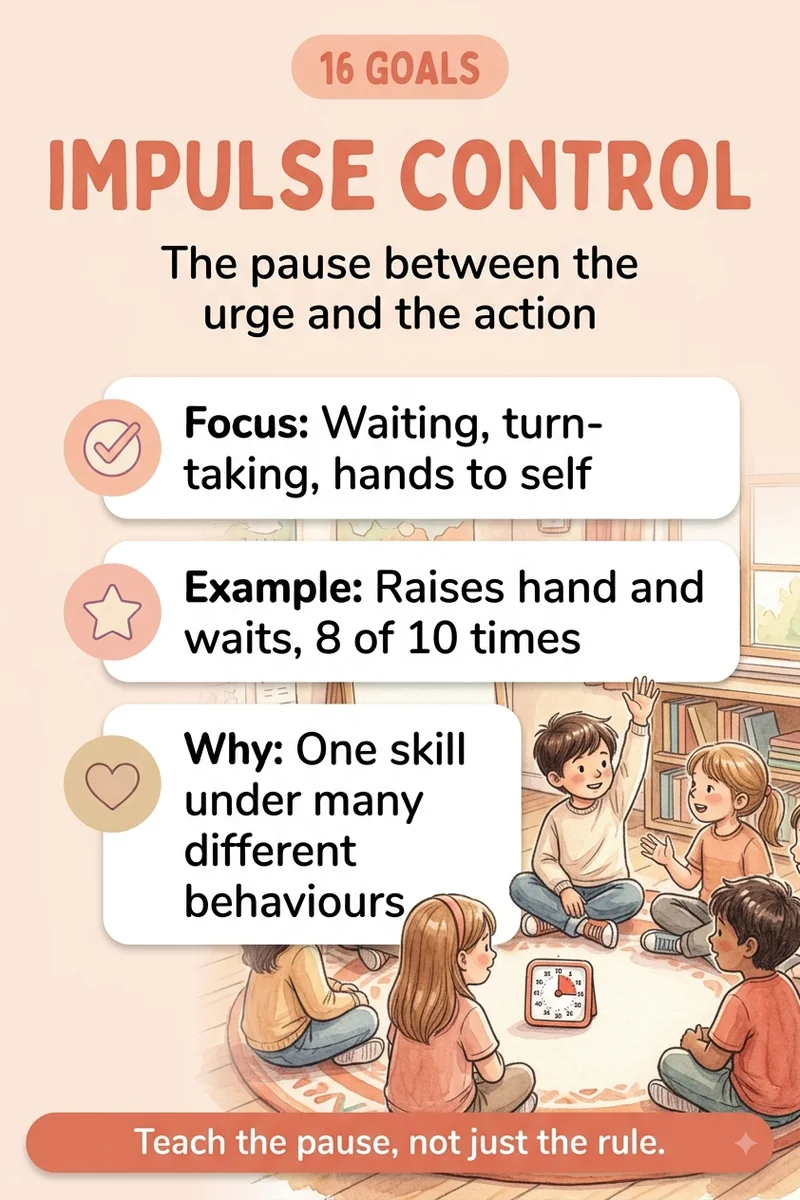
16 Impulse Control IEP Goals, Preschool Through High School
Impulse control goals cover calling out, interrupting, grabbing, leaving the seat, and answering before reading the question. The behaviours look different but the underlying skill is the same: inserting a delay where there was none.
Free · no email required · opens your browser's print dialog
Preschool & Pre-K
- 1[student] will participate in a group activity (circle time, small group) for [X] minutes without leaving the area, across 3 consecutive observations.
- 2[student] will wait for a turn during a group activity, using a visual timer or cue, without grabbing, in 4 of 5 opportunities.
- 3[student] will keep hands and body to self during a whole-group activity for [X] minutes, with no more than 1 physical redirection, across 3 consecutive observations.
- 4[student] will respond to “stop” or “no” from an adult by pausing the behavior within 10 seconds, in 4 of 5 opportunities.
Kindergarten – 2nd
- 5[student] will raise a hand and wait to be called on before speaking during whole-group instruction, in 8 of 10 observed opportunities.
- 6[student] will remain seated during independent work time for [X] minutes, with no more than 1 redirection, across 3 consecutive observations.
- 7[student] will keep hands and materials to self during instruction, with 0-1 incidents per observed period, across 4 of 5 observations.
- 8[student] will raise a hand and wait to be called on rather than blurting out an answer, in 8 of 10 observed opportunities.
- 9[student] will pause and think before answering a question or starting a task, reducing careless errors, across 4 of 5 assignments.
- 10[student] will complete a task at an appropriate pace without rushing through it, with 80% accuracy on the final product, across 4 of 5 trials.
6th – 8th Grade
- 11[student] will respond to a peer conflict or provocation using a taught strategy (walk away, use words, get an adult) rather than the target behavior, in 4 of 5 documented opportunities.
- 12[student] will accept redirection or correction from an adult without arguing, in 4 of 5 observed opportunities across all class settings.
- 13[student] will remain free of office discipline referrals related to the target behavior, decreasing from a baseline of [X] per month to [Y] or fewer.
9th – 12th Grade
- 14[student] will respond to a peer or social conflict using a taught strategy (walk away, use words, get help) rather than the target behavior, in 4 of 5 documented opportunities.
- 15[student] will accept a denied request or “no” from an authority figure without engaging in the target behavior, in 4 of 5 observed opportunities.
- 16[student] will remain free of disciplinary referrals related to the target behavior, decreasing from a baseline of [X] per semester to [Y] or fewer.
How to teach impulse control in the classroom
Impulse control improves when the pause is rehearsed before it is needed, not demanded in the moment. Teach a short, concrete routine — stop, breathe, name the choice, then act — and practice it during calm times with role-play and predictable scenarios so it is automatic under pressure. Make the expected behavior and its alternative visible: a card on the desk, a hand signal, a designated spot to go. Use pre-correction right before known hard moments ("we are about to line up; what is your plan?") rather than consequences after. Shorten wait times at first and lengthen them as success grows, and build in legitimate movement or fidget options so the body has an outlet. Reinforce the pause itself — the moment the student stops and thinks — even when the eventual choice is imperfect, because the pause is the skill being built. Debrief slips briefly and forward-looking: what was the trigger, what is the plan next time.
How to measure it
Frequency counts are the right tool — a tally on a sticky note or a golf counter during one consistent period. Sample the same period each day rather than trying to count all day, or the data collection collapses within a fortnight.
Where these goals come from
Each goal above is drawn from a grade-band goal bank, where you can see it alongside the other targets it is usually paired with: Behavior goals, 6th – 8th Grade; Behavior goals, 9th – 12th Grade; Behavior goals, Kindergarten – 2nd Grade; Behavior goals, Preschool & Pre-K; Executive Function goals, Kindergarten – 2nd Grade.
Related skills
A flat following-directions goal is often really a breakdown in one of these skills. If the data does not move, check whether the real target is here instead:
- Emotional Regulation IEP goals — recognising a feeling and doing something about it before it escalates
- Self-Monitoring IEP goals — noticing your own performance while it is happening
- Following Directions IEP goals — doing what was asked, the first time, without it being repeated
Common questions
Is impulse control a behavior goal or an executive function goal?
It sits in both. It is an executive function — the ability to inhibit a response — but it is almost always written and tracked as a behavior goal because it is observed through actions: calling out, grabbing, leaving a seat, physical responses. The teaching, though, is skill instruction, not just consequences.
Should the goal focus on stopping the behavior or on a replacement?
A replacement. "Will not call out" gives the student nothing to do instead. Effective goals name what the student will do — raise a hand and wait, use a signal, move to a designated spot, ask for a break — so there is a behavior to teach and reinforce.
How do you measure impulse control without just counting incidents?
Count the replacement behavior, or measure latency and rate: how long the student waits when asked, or how often they use the taught strategy per period. A pure incident count tells you the behavior happened but not whether the skill is growing.
Further reading
Need a goal built from your student's baseline? Generate one for your student →