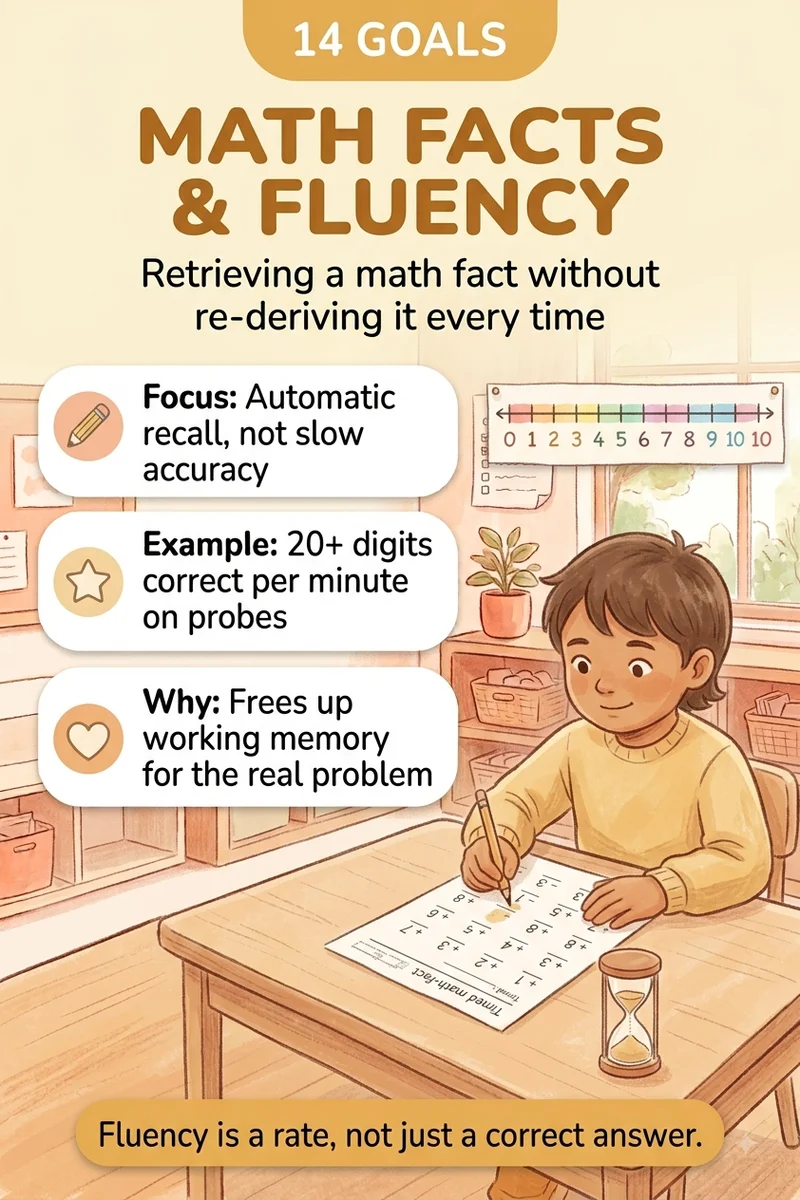
14 Math Facts & Fluency IEP Goals, Preschool Through High School
Fact fluency is what frees up working memory for the actual problem. A student who has to rebuild 7×8 by skip-counting on their fingers has no attention left for the multi-step word problem the fact was supposed to serve — the fact deficit shows up disguised as a reasoning problem.
Free · no email required · opens your browser's print dialog
Kindergarten – 2nd
- 1By [date], [student] will solve addition facts within 10 with 90% accuracy at a rate of 20+ digits correct per minute across 3 consecutive CBM probes.
- 2By [date], [student] will solve subtraction facts within 10 with 90% accuracy across 3 consecutive 1-minute timed probes.
- 3By [date], [student] will solve addition and subtraction facts within 20 with 85% accuracy across 4 of 5 trials.
- 4By [date], [student] will use a counting-on strategy rather than counting all when adding, in 4 of 5 observed opportunities.
- 5By [date], [student] will add two 2-digit numbers with regrouping with 80% accuracy across 4 of 5 trials.
3rd – 5th Grade
- 6By [date], [student] will solve multiplication facts 0-12 with 90% accuracy at a rate of 40+ digits correct per minute across 3 consecutive CBM probes.
- 7By [date], [student] will solve division facts related to known multiplication facts with 85% accuracy across 4 of 5 trials.
- 8By [date], [student] will multiply a 2-digit number by a 1-digit number with 80% accuracy across 4 of 5 trials.
- 9By [date], [student] will divide a 3-digit number by a 1-digit number with remainders with 75% accuracy in 4 of 5 trials.
- 10By [date], [student] will explain the relationship between multiplication and division for a given fact family with 80% accuracy.
6th – 8th Grade
- 11[student] will recall multiplication facts 0-12 automatically, without skip-counting or finger use, with 90% accuracy at a rate of 30+ facts correct per minute across 3 consecutive CBM probes.
- 12[student] will apply known multiplication facts to solve a multi-digit multiplication problem without pausing to derive the fact, with 80% accuracy across 4 of 5 trials.
- 13[student] will recall division facts related to the 0-12 multiplication table automatically, with 85% accuracy at a rate of 25+ facts correct per minute across 3 consecutive probes.
- 14[student] will select and apply the correct operation from a mixed set of fact-family problems (addition, subtraction, multiplication, division) with 80% accuracy across 4 of 5 trials.
How to teach math facts & fluency in the classroom
Fact fluency is built after the student understands the concept, then through brief, daily, spaced practice — not timed tests used as instruction. First confirm the student can explain and model the operation with objects or drawings; drilling facts a student does not understand produces fragile memorization. Then teach fact strategies (doubles, making ten, counting up, using known facts) so a forgotten fact can be rebuilt quickly. Practice small sets to mastery with immediate feedback, and space the review so facts are revisited over days and weeks. Track facts known automatically, and add new facts only as old ones stabilize. Keep it low-stress; anxiety blocks retrieval, and a student who freezes on a timed page may know the facts. Automatic core facts free up working memory for multi-step and word problems.
How to measure it
Use a timed digits-correct-per-minute probe, not just an accuracy percentage. Automaticity is a rate, not just a correctness score — a student who is 100% accurate but takes 40 seconds per fact has not yet reached fluency.
This is one piece of a larger topic. All math IEP goals by skill →
Where these goals come from
Each goal above is drawn from a grade-band goal bank, where you can see it alongside the other targets it is usually paired with: Math goals, 3rd – 5th Grade; Math goals, 6th – 8th Grade; Math goals, Kindergarten – 2nd Grade.
Related skills
A flat following-directions goal is often really a breakdown in one of these skills. If the data does not move, check whether the real target is here instead:
- Working Memory IEP goals — holding information in mind long enough to act on it
- Problem Solving & Flexibility IEP goals — trying a second approach when the first one fails
- Task Initiation IEP goals — the gap between knowing what to do and starting to do it
Common questions
What is the difference between a fact fluency goal and a computation goal?
Fluency is about retrieval speed — recalling 7x8 rather than rebuilding it. Computation is about applying the procedure correctly. A student who is 100% accurate but takes 40 seconds per fact needs a fluency goal; one who is fast but wrong needs a computation goal.
How do you measure math fact fluency?
With a timed probe reporting digits or facts correct per minute, not an accuracy percentage alone. Confirm which CBM system your district uses first — aimsweb, easyCBM and district-built probes report different benchmark numbers, so a rate copied from a chart may not match your school's.
Further reading
Need a goal built from your student's baseline? Generate one for your student →