20 IEP Goals for ODD and Defiant Behavior
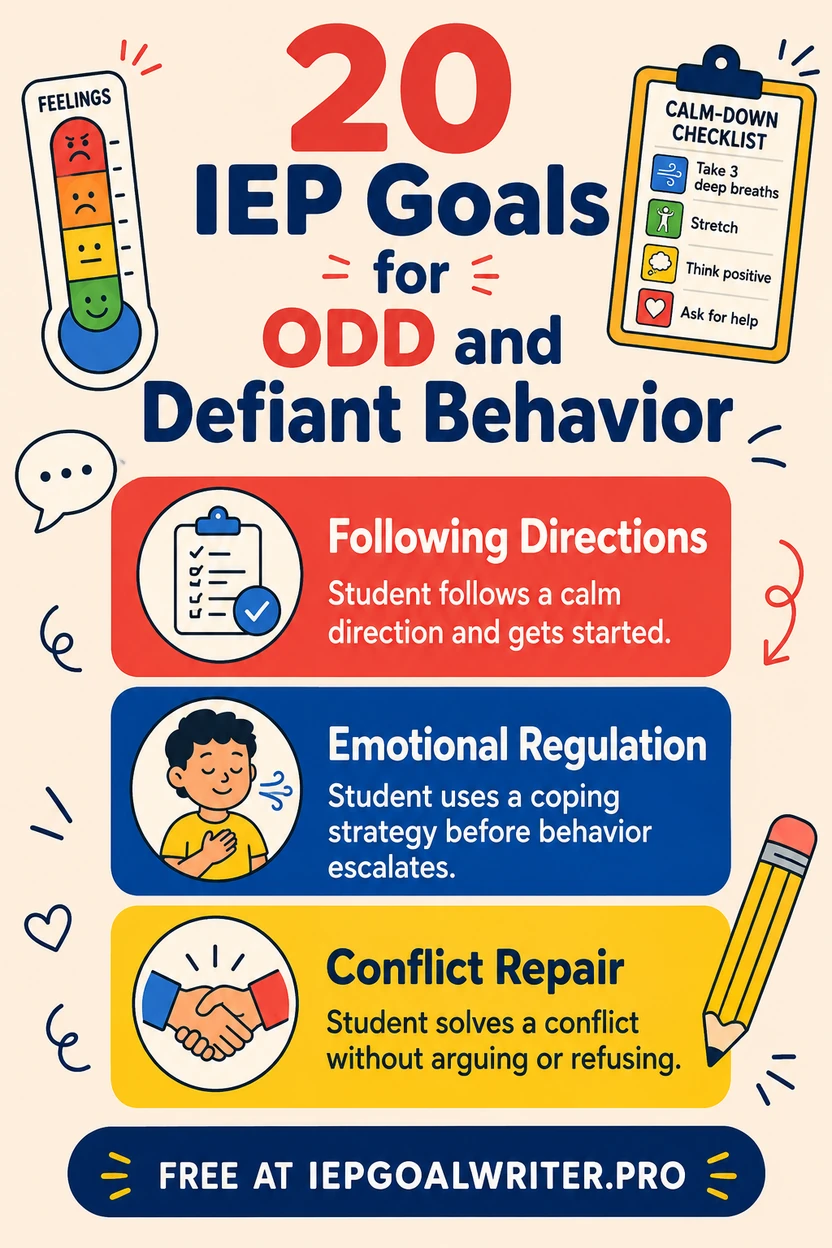
IEP goals for defiant behavior should teach a replacement skill in the situation where behavior occurs, not require blanket compliance. For example: By [date], [student] will use an agreed break or help request after a nonpreferred direction instead of refusing or arguing in 4 of 5 observed opportunities, as measured by a behavior log.
Oppositional defiant disorder is a clinical diagnosis, not an IDEA category. A student may be eligible under Emotional Disturbance, Other Health Impairment, or another category only when the evaluation, educational impact, and need for specialized instruction support that decision. The goals below are written around observable school routines: responding to directions, regulating escalation, repairing conflict, and using replacement behavior. Start with FBA/BIP and baseline data, not a label or a desire for obedience.
Responding to Directions
- 1.By [date], [student] will begin the first step of a clearly stated nonpreferred classroom direction within 2 minutes after receiving the direction and one allowed clarification in 4 of 5 opportunities, as measured by latency and task-initiation data.
- 2.By [date], [student] will repeat or paraphrase a 2-step direction before beginning when the student is unsure what is expected in 4 of 5 observed opportunities, as measured by teacher direction-check data.
- 3.By [date], [student] will use the agreed help or break request instead of arguing, leaving, or refusing when a task demand feels too difficult in 80% of documented demand situations across 2 settings, as measured by behavior replacement tally data.
- 4.By [date], [student] will complete an agreed first-work-then-choice sequence following a nonpreferred direction in 4 of 5 opportunities with no more than 1 reminder, as measured by contingency-routine checklist data.
- 5.By [date], [student] will return to the assigned direction after an approved break and complete the defined work chunk in 4 of 5 documented breaks, as measured by break-return and work-completion data.
Emotional Regulation
- 1.By [date], [student] will identify the student’s escalation level on a taught 3-point regulation scale before behavior reaches the highest level in 4 of 5 observed incidents, as measured by self-monitoring and staff comparison data.
- 2.By [date], [student] will select and use one taught de-escalation strategy within 2 minutes of noticing an early escalation cue in 4 of 5 opportunities, as measured by behavior log data.
- 3.By [date], [student] will remain in the designated regulation area for the agreed interval and return when the timer or routine ends in 80% of uses across 3 consecutive weeks, as measured by duration and return data.
- 4.By [date], [student] will state or indicate the problem in neutral language after a conflict rather than using threats, insults, or personal attacks in 4 of 5 restorative conversations, as measured by staff rubric data.
- 5.By [date], [student] will rate readiness to problem-solve after a regulation period and request more time or begin the repair step appropriately in 4 of 5 opportunities, as measured by student regulation form data.
Conflict De-Escalation
- 1.By [date], [student] will use one taught sentence starter to disagree with an adult or peer without yelling, insulting, or walking away in 4 of 5 role-play or natural opportunities, as measured by social-behavior rubric data.
- 2.By [date], [student] will listen to another person’s statement for at least 30 seconds without interrupting during a structured repair conversation in 4 of 5 conversations, as measured by staff observation data.
- 3.By [date], [student] will state one own-perspective fact and one other-perspective fact about a conflict before proposing a solution in 4 of 5 guided problem-solving opportunities, as measured by conflict-resolution worksheet data.
- 4.By [date], [student] will choose one mutually acceptable solution from at least 2 options during a conflict review in 4 of 5 opportunities with no more than 1 prompt, as measured by problem-solving checklist data.
- 5.By [date], [student] will complete the agreed repair action, such as replacing materials, redoing a task, or using a respectful statement, after a conflict in 80% of documented incidents, as measured by restorative-action completion data.
Replacement Behaviors
- 1.By [date], [student] will request clarification when a direction is perceived as unfair or unclear instead of immediately refusing in 4 of 5 relevant opportunities, as measured by replacement-behavior tally data.
- 2.By [date], [student] will ask for one acceptable choice within the assigned task when choice is available in 4 of 5 opportunities across 2 classes, as measured by teacher observation data.
- 3.By [date], [student] will use a taught delay phrase such as “I need a minute” and remain in the area while preparing to respond in 4 of 5 high-demand situations, as measured by behavior-log data.
- 4.By [date], [student] will use the agreed problem-solving form to identify the demand, obstacle, and next doable step with all 3 fields completed in 4 of 5 incidents, as measured by completed problem-solving forms.
- 5.By [date], [student] will earn the defined class participation outcome by using replacement behaviors across the full routine rather than by absence of a diagnostic label in at least 80% of scored routine intervals across 3 weeks, as measured by behavior intervention progress-monitoring data.
A Worked Example: One Student, PLAAFP to Data Plan
Present levels: Jamal completes oral discussion and short writing successfully when he understands the first step. During 15 observed independent-writing directions, he argued, put his head down, or left the task in 9; FBA data showed that difficult or unclear written work commonly preceded the behavior. When a teacher offered a two-choice start plan before escalation, Jamal selected a first step and began within 3 minutes in 6 of 8 opportunities. He independently requested clarification in only 2 of 15 observations. The educational impact is delayed task initiation and loss of writing practice, not the fact that Jamal “is defiant.”
Annual goal derived from that baseline: By [date], when an academic direction is unclear or feels too difficult, Jamal will use one taught replacement response—request clarification, choose between two approved first steps, or request a brief check-in—and begin the agreed first work chunk within 3 minutes in 4 of 5 opportunities, as measured by latency and replacement-behavior data. Specially designed instruction should explicitly teach and rehearse those responses when Jamal is calm, pre-correct them before high-risk routines, and reinforce successful return to work.
Goal versus accommodation: Breaking a long assignment into visible chunks, offering a brief check-in, or clarifying directions may be accommodations or instructional supports. The annual goal is Jamal’s use of an efficient replacement response and return-to-task routine. A compliance-only goal such as “will obey adults” would not identify the skill the FBA says is missing.
Data plan: Record antecedent/routine, replacement response used, prompt level, latency to begin, first chunk completed, and whether escalation occurred. Compare data by task type. If Jamal uses the replacement response but still cannot complete the first chunk, review academic skill demand and accommodations rather than interpreting the behavior goal as failed.
How These Goals Change by Grade Band
In early grades, teach one or two concrete replacement responses with visuals and repeated practice during a narrow routine: ask for help, choose the first step, use a break card, then return. The progression should reduce adult prompting and shorten the time between frustration and a successful alternative response.
In grades 3–5, add respectful disagreement, clarification questions, choice-making within teacher limits, problem solving after conflict, and completion of a defined work chunk. Data should distinguish refusal that follows a skill mismatch from refusal maintained by a different function.
In middle and high school, goals should look more like self-management and self-advocacy: negotiating an appropriate deadline, identifying when a task barrier is academic versus emotional, using de-escalation language, repairing conflict, and returning to required work. Avoid infantilizing older students with token-compliance goals; the instructional target is a functional replacement behavior that works with multiple adults and settings.
Collecting Data Without Adding a Full-Time Job
Use data tied to the replacement skill, not a daily “good/bad” rating. For directions, record latency to begin, whether the student asked for clarification or used another taught response, prompt level, and whether the first defined work chunk was completed. For conflict or escalation, record the antecedent, earliest observable cue, replacement behavior, recovery time, and return outcome.
When an FBA/BIP is involved, keep the goal measure compatible with the function identified by the team. A student escaping work because the task is inaccessible needs different instruction from a student seeking predictability, adult interaction, or another outcome. Do not infer function from one incident; use the team’s actual functional assessment data.
Build decision rules around the skill. If replacement responses increase but work completion does not, review task difficulty, SDI, and accommodations. If success occurs only with one adult, program generalization with another familiar adult before raising the criterion. If escalation falls but the student is simply shutting down silently, the team has not necessarily taught a better access skill.
Personalization warning: Oppositional defiant disorder is a clinical diagnosis, not an IDEA category, and an IEP should not be a behavior-compliance contract. Use evaluation and FBA/BIP data to identify the observable, teachable school skill. Do not write goals that require unquestioning obedience, suppress disability-related communication, or punish an appropriate request for help or a break.
FAQ
Paste your assessment data and generate an IDEA-compliant, individualized goal in seconds.
Try it free →